


Beyond Sets and Reps: Weaponizing your energy systems

Optimize your effort: How to look past the numbers on the page and unlock the real power of your routine.
By Dan Thorpe | For the Strength in Depth Podcast - listen to the Audible version here
Part 1: The Question
"What are the optimal sets and reps for my goals, and how much rest do I actually need between them?"
To answer this, we have to look past the surface of the workout.
Past arbitrary recommendations,
We have to look at the biological "why" that dictates every rep you perform.
Before i carry on down this track, if you are only bothered with the how and not the why, jump off at this station for the basic version of this article.
But if the science interests you, you like to know the why behind the how then stay on the train.
The Engines Under the Hood
You've just hit a pb, you've just done 1 rep with the heaviest weight you've ever done. So why cant you do another, you've just done it?.....Its too heavy you say.....BUT WHY does that matter?
We are all quite aware there is an inverse relationship between how hard you push and how long you can last.
So before we dive into the specifics of sets and reps, we have to discuss the 3 main "Systems" that govern the way you produce force.
This is what dictates the amount of reps and the amount of rest we use when training.
something like this;

The reason You can’t do 15 reps with your 3-rep max,
the same reason a Tesla can't maintain its "Plaid" launch speed for a full hour:
The energy discharge is too violent to sustain.
Think of your body as a "hybrid Fuel" high-performance machine with three distinct ways to move the wheels:
Your body has 3 energy systems;
These 3 systems deliver power and recharge at varying speeds and magnitudes.
And depending on whether you have to run away from a predator or walk to the shops the body will engage one of these 3 systems to do the bulk of the work.
The 3 systems.
⚡ The Performance Battery: Designed for massive, near-instant "God-Mode" torque. It dumps energy at lightning speed, but it drains in seconds. This is your Strength & Power engine. this is known as the Phasphagen or ATP_PC system
⛽ The Petrol Engine: Still incredibly powerful, but built for the "mid-range." It lasts longer than the battery discharge, but eventually, the heat and the exhaust (the "smoke") will force you to pull over. This is your Muscle car engine engine. AKA the Glycolitic system
🏙️ The High-Voltage Grid: This is your Aerobic Engine. It’s the invisible infrastructure that stays on 24/7. While it isn't built for a 2-second launch, it provides a relentless, infinite stream of power. Most importantly, it is the Supercharger—it’s what re-fills the Battery and clears the Petrol smoke while the car is "parked" between sets.
The speed at which you need that fuel—the "intent" of your set—dictates exactly which engine system your body leans on.
we can see this as a spectrum or a timeline, check out the graphic below.
you'll see what "engine" your body uses when you try and put down maximum power, aim to move something really heavy vs hiking up a hill.

Each system provides a different level of output and they recharge at differing rates.
So you can see where the parameters in the previous table came in.
why does it matter what system is used?
because the precise things you go to the gym to change are tightly bound to one of those systems.
And as each of these engines is tightly bound to a certain capacity, you will adapt the capacities associated with the system you spend the most time or energy in.
see the table below;
output/Training Goal | Primary capacity & Adaptation | What the Body is Doing | Dominant Energy System |
Power / Max Strength | Central Nervous System (CNS) | Upgrading the "software" to recruit all available muscle fibers rapidly and simultaneously. | Phosphagen (ATP-PCr) |
Muscle Gain (Hypertrophy) | Muscular System (Structure) | Expanding "real estate" (muscle size) to store more fuel and handle more mechanical tension. | Glycolytic (Anaerobic) |
Endurance | Cardiovascular & Metabolic | Increasing mitochondrial density and capillary "roads" to deliver oxygen and clear waste. | Oxidative (Aerobic) |
"The body is a lazy genius. It will only spend the energy to adapt the specific part of the 'engine' that is currently under highest stress. If you run out of breath, it builds better pipes (Endurance). If the weight is heavy-heavy, it upgrades the signal (Strength). If the muscle runs out of fuel and tears, it builds a bigger warehouse (Hypertrophy)."
The Human Engine: Energy Systems
System | The Dashboard Icon | Duration & Intensity | Recovery Logic |
ATP-CP | ⚡ Performance Battery | < 10 Sec (100% Effort) | Full Recharge Required. You can’t "quick-charge" high voltage. If you go too soon, the bar speed drops and the power dies. |
Glycolytic | ⛽ Petrol Tank | 30–90 Sec | Partial Refill. You have a large tank, but you need 60–90 seconds to let the engine cool down and vent the exhaust before the next lap. |
Aerobic | 🏙️ The Grid | Constant / Invisible | The Supercharger. This is your underlying infrastructure. An "Elite" grid refills your battery and clears out the petrol smoke faster while you rest. |
Key Takeaways:
Don't drag race on 5% battery: If you're training for power, wait for the green light.
The Grid is everything: The stronger your aerobic base (The Grid), the less time you spend "plugged into the wall" between sets.
Avoid the Smoke: If you don't let the Petrol system vent, your performance will eventually stall out from overheating (acidosis).
and this is essentially a simplified way to think abut your energy systems,
It’s easy to look at those three engines—the Performance Battery, the Petrol Engine, and the High-Voltage Grid—and see them as separate parts of a machine. But in the human body, they all have one thing in common:
They are all used to recharge the same battery.
Whether you are red-lining the Battery for a 1RM or chugging along on the Grid during a 5k run, your muscles don't actually "speak" petrol or electricity, your muscles are blind to the source, they only accept one form of payment to keep producing force.
Those 3 systems aren't different fuels at all, they all have one non-negotiable role, and that is to make your bodies master molecule, something called ATP.
ATP: The Master Molecule
aka the universal currency
The Universal Energy Currency
Understanding how we generate and regenerate energy is the "skeleton key" to performance.
It explains why we fatigue, how we recover, and—most importantly—what strategies you can implement to work with your biology rather than against it.
Whether you are a pure strength athlete, a runner, or simply training for longevity, every movement requires muscle, and every muscle requires energy.
This makes the "Dark Arts" of bioenergetics relevant to everyone.
But once you understand the "Why" behind your programming, the mystery vanishes.
You’ll realize why 3 reps is a completely different biological event than 20, and why resting for three minutes instead of thirty seconds isn't "laziness"—it’s a tactical decision.
The Biological Alchemy
Every function of your body requires fuel. While we know that fuel is derived from food, there is a complex transformation that happens between your last meal and your next set of heavy squats.
Your body cannot run on "chicken and rice" directly; it must convert that food into a molecule called Adenosine Triphosphate (ATP).
ATP is your cells' only currency.
A light bulb doesn't care if its electricity was generated by a wind turbine or a coal plant—it just needs electrons to flow. Similarly, your muscles don't care if your energy came from a steak or a donut; they only recognize the "flow" of ATP.
The Billion-Battery System
The simplest way to visualize this is to think of ATP as a rechargeable battery.
Imagine a toy car. To make it move, you insert a fully charged battery (ATP). As the car drives, the battery loses its juice until it’s dead (ADP). To keep playing, you must take that dead battery, click it into a wall charger, and wait for it to be primed for use again.
This is exactly how your body works:
ATP (The Full Battery): A molecule with three phosphates "coiled" together like a high-tension spring.
The "Pop": When you lift, a phosphate pops off, releasing a burst of energy.
ADP (The Dead Battery): You are left with only two phosphates and no power.
The secret to elite performance isn't just how much ATP you have stored—spoiler: it’s almost none.
The secret lies in your Mitochondria and your energy systems acting as the "wall charger."
Your performance and your training in the gym is dictated by how fast your internal engines can manufacture and "re-click" those batteries back together on the fly.
ATP & The 3 main energy systems;
Adenosine Triphosphate.

the key is in the name. Basically its a molecule (of adenosine) with 3 bits of tightly coiled stuff attached (phosphates) together by high energy bonds.
How the Energy is Released
When your brain sends a signal to your muscles, whether to bench press or squat or to your lungs to breathe, your body "breaks" one of those coiled up things and the bond holding them together is broken off violently, so now there is only 2 things.
This is why a max-effort lift feels like an explosion—it's billions of these little bonds snapping at once.
When that bond breaks, it releases a sudden burst of energy that your cells use to perform work.
Once that third thing (phosphate) is gone, the molecule is no longer ATP; (because there is only 2 things instead of 3, hence the TRI becomes DI) what was ATP (3 things) is now ADP (Adenosine Diphosphate)—basically a battery that has been drained of its primary charge.
The Coach’s Analogy: Imagine a glow stick. To get the light, you have to "snap" it. That snap releases the energy. But once it's snapped, you can’t just snap it again to get more light—you have to find a way to reset the chemical reaction.
The "Catch-22" of Human Performance
Here is the catch: Your muscles only store enough "pre-made" ATP to power about 2 to 4 seconds of maximum effort work.
To keep moving, your body has to "re-charge".
it must turn the "dead 2 bit ADP battery" back into a charged 3 bits ATP battery.
And luckily for us it does this almost instantly, by grabbing a spare thing a spare (phosphate) from somewhere else and re-attaching it.
The Gain Train
its a bit like having a train driver throw coal on to keep the combustion going, On a steam train the ATP is like the fire - heat plus oxygen plus a fuel - 3 things see, the driver keeps throwing a third thing back on that he has in storage, coal.
This is where the 3 Energy Systems come in. They aren't different types of energy; they are simply three different ways to put that 3rd thing (phosphate) back in so you can keep the train going or whatever analogy helps you envision the process.
so now we know we have 3 distinct systems the body uses to power us at all the varying levels of intensity we require.
lets take deeper look at those systems.
The Three Systems: An Overview
Depending on how fast the train is going and how quick you need that energy, your body chooses one of those 3 systems or "mini factories" to rebuild your ATP:
these are the 3 engines we spoke of earlier -
The Phosphagen System (ATP-PC): The "Emergency Reserve/performance battery" – Instant but very limited.
The Glycolytic System (Anaerobic): The "Petrol tank" – Powerful but produces a "waste product."
The Oxidative System (Aerobic): The "High voltage grid" – Efficient and endless, but slow.
Now lets connect these to the work you perform, because if you go super heavy or super fast (relatively) you'll use a different system, a different fuel to stoke the fire compared to if you go for a for a hike up a hill.
System 1 - The Phosphagen System (The Power Battery)
Used for: Absolute Strength & Power
If you are performing a 1RM back squat, a 100m sprint, or a max-effort vertical jump, your body doesn't have time to wait for extra complex chemical reactions. It needs a way to fuel that fire right now.
This is the Phosphagen System.

Your body has about 2-4 seconds of ATP stored in your muscles, like a loaded gun ready for action, but when that has been exhausted the body uses a helper molecule stored right there in your muscles.
And you may have heard of it: Creatine Phosphate (CP). This is just one reason why we tell you take the stuff!
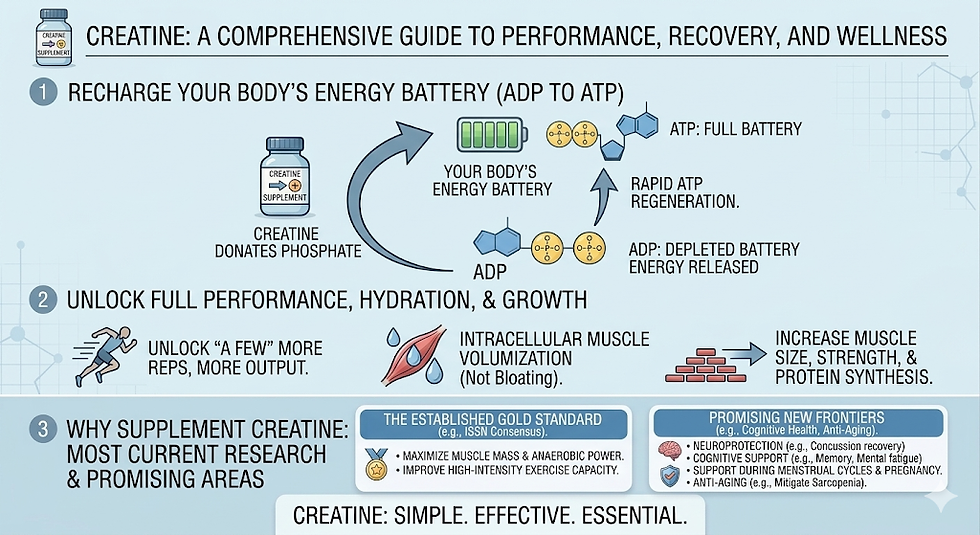
How it works:
Think of a guy standing next to the train driver with a shovel already full of coal. The second the driver throws on some coal, the guy standing next to the driver hands over a full spade of his creatine phosphate coal to turn the ADP back into ATP to keep the fire roaring!
So the speed is instant energy from this stored creatine which provides roughly another 8 to 10 seconds of "GOD-MODE" power.
And there lies the problem - Ultimate power..…teeny tiny amount of time!
You see, we only have a tiny amount of Creatine Phosphate in the muscle. Once those 8–10 seconds are up, that guy with the shovel is empty, he's out. He has to go back to the storage shed to get more. and unfortunately that shed is at the other end of the train, it takes them 3 - 5 mins to go and get it.
For that reason, If you’re training for Absolute Strength (1–5 reps) you require a 3–5 minute rest period until you are good to go at almost the same capacity because you are draining this specific tank. It takes roughly 3 plus minutes for your body to chemically "re-stock" that Creatine Phosphate.
Dan’s Deep Dive: "If you only rest for 30 seconds, the guy with the shovel is still empty. You try to lift the heavy weight again, but the fuel isn't there. Your body is forced to switch to a 'slower' fuel, the bar speed drops, your technique gets sloppy, and you've officially left the max Strength Zone."
System 2 - The Glycolytic System (The High-Octane coal)
Used for: Hypertrophy & Strength Endurance
So, what happens when those first 10 seconds are up? The guy with the shovel is out of coal, he’s dropped his spade, and he’s heading to the back of the train. But you’re only on rep 4 of a set of 12 now. The train cannot stop.
This is where your second system, the Glycolytic System, kicks in. If the Phosphagen system was "instant access" coal, the Glycolytic system is the Secondary Coal Hopper.
This hopper is huge, but the coal inside isn't ready to use—it’s stored as Glycogen (sugar) in your muscles and blood. Before the driver can throw it on the fire, he has to break those big chunks of coal down into smaller pieces first.
The Catch: Its a dirty process!
Because the driver is now smashing up coal as fast as he can to keep the train moving, the engine room starts to get filthy. Unlike the clean-burning Creatine from the first system, breaking down sugar for energy is a "dirty" process. It creates byproducts—Lactate and Hydrogen ions.
Think of this as thick, black smoke and stinging ash filling up the cabin.
The "Burn": That stinging ash is the "burn" you feel in your quads during a high-rep set.
The Failure: Eventually, the smoke gets so thick that the driver can’t see, he can’t breathe, and the machinery starts to seize up. Your muscles "fail" not because you’re out of coal, but because the engine room is too choked with smoke to keep the fire going.
This is the secret to Hypertrophy and the Repeated Effort Method. When we train for muscle size (8–12 reps), we aren't waiting for the guy to get back from the storage shed with the "clean" coal. We are simply waiting for the Cleanup Crew to clear just enough smoke out of the cabin so the driver can see the controls again.
The Goal: You aren't resting to feel 100% fresh. You are resting just long enough (60–90 seconds) to clear the acidic "haze" (Hydrogen ions) so you can keep the train rolling at a decent pace.
The Result: It won't be "full-tilt" power like your 1RM, but it’s "decent enough" to make serious gains. By keeping the rest short, you are forcing the muscle to perform while it's still under stress.
Coach’s Note: "If you rest 5 minutes between sets of 10, the cabin gets too clean. You lose that metabolic 'pressure' that actually triggers growth. You want to stay just on the edge of the smoke—that’s where the gains are made."
The Lactic Acid Myth
"Lactate isn't the exhaust fumes of your engine; it's the recycled fuel that keeps the lights on."
Before we go any further, we need to clear something up. You’ve been told the "burn" is Lactic Acid and that it's a waste product that makes you sore.
The reality? Lactate is the hero, not the villain.
The Real Villain: The "burn" is caused by Hydrogen Ions. These are acidic byproducts that build up in the engine room and interfere with your brain's electrical signals to your muscles. That is what causes failure.
The Hero (Lactate): Your body produces Lactate to actually buffer that acidity and recycle it back into energy. It is a high-octane fuel that your heart and slow-twitch fibers crave.
The "Cleanup Crew": If you’re gassing out, it isn’t because you have too much "acid"—it’s because your Aerobic System isn't efficient enough to vacuum the carpet while the party is still going.
The Takeaway: When you rest for 60–90 seconds in a hypertrophy set, you aren't waiting for "Lactic Acid" to leave. You are waiting for the Cleanup Crew to mop up those Hydrogen Ions so the pH level in your muscle resets enough for you to go again.
System 3 - The Oxidative System (The Infinite Rail-Line)
Used for: Longevity, Recovery, & Pure Endurance
If the first two systems were about how fast we can burn fuel to keep the train from stopping, the Oxidative system is the Oxygen coming in through the vents and the Track itself.
Unlike the "Emergency" or "High-Octane" tanks, this system is aerobic, meaning it requires oxygen to turn fats and sugars into ATP. It’s the most efficient factory we have.
The Persistence Beast: Why You Are Built to Last
While a cheetah is faster and a gorilla is stronger, humans are the world champions of Persistence Hunting. Because we have millions of sweat glands and we run on two legs, we can dissipate heat better than any other mammal. In the heat of the African savanna, our ancestors would simply trot after a kudu or a zebra. The animal would sprint away, but it couldn't "clear the smoke" fast enough. It would eventually overheat and collapse. We caught them because we have an Oxidative System that never quits.
The Real Magic: The Cleanup Crew
For a strength athlete, the Oxidative system has one vital job: It is the "Vacuum Cleaner" for the engine room. While you are sitting on the bench resting, your Aerobic system is:
Opening the Windows: Venting out the "smoke" (the Hydrogen ions) that cause the burn.
Refilling the Shovel: Helping the guy with the Creatine (ATP-PC) get back from the storage shed with a fresh spade of coal.
Recycling the Juice: Taking that Lactate (the hero fuel) and turning it back into usable energy.
The "Why": This is why a "Hybrid" athlete with a solid aerobic base recovers faster between heavy sets. Their "cleanup crew" is elite.
The Signal and the Structure (Specific Adaptation)
Now i bring you to another principle known as - Specific Adaptations to Imposed Demands (The SAID Principle).
Your body is the ultimate economist. It will not spend energy building a structure it doesn't think it needs.
Training the Phosphagen System (The Neural Upgrade)
The Signal: "We need more power, and we need it now."
The Adaptation: It focuses on Neuromuscular Efficiency.
The Structure: You are upgrading the "Wiring" (the CNS). You get better at Motor Unit Recruitment and Rate Coding.
You get "strong-strong" without necessarily getting "big-big."
You are teaching the brain to "speak louder" to the muscles you already have.
Training the Glycolytic System (The Structural Upgrade)
The Signal: "The engine room is failing due to acidity; we need more storage."
The Adaptation: This is where Hypertrophy lives.
The Structure: The body increases the size of the muscle fibers and the fluid around them to store more glycogen.
You are building a bigger "fuel tank" and upgrading the Hardware.
Training the Oxidative System (The Metabolic Upgrade)
The Signal: "We need to clear the smoke faster and keep the lights on longer."
The Adaptation: The body increases Mitochondrial Density (mini-factories) and Capillarization (more "pipes").
The Structure: You are upgrading the Logistics.
"Think of it like this: If you train the Phosphagen system, you’re upgrading the Software. If you train the Glycolytic system, you’re upgrading the Hardware. You can’t expect a software update to give you a bigger engine. This is why a logical program 'surfs' the spectrum."
The Signal and the Noise (The Interference Effect)
We’ve established that the body follows the signal. But what happens when you try to send two completely different signals at the same time?
You create Metabolic Noise.
Think of your body as a Project Manager with a strictly limited budget. It can’t fund every project at once. When you train, you are essentially "pitching" a project to the boss.
The Molecular Tug-of-War
In your cells, there are two main "Foremen" competing for that budget:
mTOR (The Construction Crew): This foreman is in charge of Hardware. When you lift heavy and create a "pump," mTOR construction crew shows up with bricks and mortar to build bigger, thicker muscle fibers.
AMPK (The logistics Team): This foreman is in charge of Logistics. When you do long-distance cardio, the AMPK logistics team shows up to streamline the engine, make the pipes more efficient, and keep the train "light" for the long haul.
The Catch: the logistics team can actually fire the Construction Crew.
If you finish a brutal leg session (calling for the Construction Crew) and immediately go for a maximal-effort 10-mile run (calling for the logistics Team), the logistics Team tells the builders: "Stop what you’re doing. We don't have the budget for heavy bricks today; we need to stay lean and efficient."
You’ve essentially sent the builders home before they even laid a single brick.
The Hyrox Trap
This is exactly where people training for hyrox get sucked into training that looks cool and is good fun but doesn't necassarily deliver the goods: AKA you try to train the entire sport in every single session.
When your training program is nothing but "Hyrox Simulations," you aren't building wealth; you’re just throwing loose change at ten different jars. Nothing ever gets rich.
If you really want to improve your Hyrox (or any sport), you have to take your Hyrox apart and explode it out.
Look at the individual components. Look at the different qualities required—from pure aerobic capacity to force production.
Where do you lack?
What requires the biggest payment on the day?
Where should i invest my training cash now?
If you don't identify which system needs the investment, you're just guessing.
The "Compromised" Fallacy
And every hyrox competitiors faverite word is Compromised Running.
Everyone wants to spend their week doing "simulations"—running on heavy legs after a set of lunges or a sled push.
But here is the hard truth: Compromised running is usually just compromising your results.
Think of your training like an iceberg. The ability to transition from a station to a run is the tiny tip visible above the water. It’s a specific skill, a "feeling" you need to be familiar with so you don't panic on race day.
But the massive, heavy base of that iceberg—the part that actually wins races—is made of two distinct, uncompromised pillars: Elite Aerobic Capacity and Raw Power Output.
The best competitors are Strong with a massive engine and they have learned to tie them together.
Running makes up a massive percentage of this event. If you are constantly training your running while compromised, you are simply training to run slow.
You’ll never develop the "top end" engine required to compete. Conversely, if you try lifting when you’re still gassed from a "slow" run, you’ll be too weak to develop the muscle or strength needed to move the sled.
You end up being okay at being mediocre at both.
Identify Your Deficit
Different athletes require different investments. These two individuals should not be training the same way:
The Lifter: Needs to stop chasing "shitty cardio" and start building a high-fidelity aerobic base in isolation.
The Runner: Needs to stop chasing "volume" and start building the structural integrity to move heavy loads without breaking down.
Mixed Signals
The body is a biological computer. If you send it conflicting data, you get a corrupted output. This is the "Grey Zone" at its worst:
The Strength Glitch: If you’re trying to build maximal force but you take 60-second rest periods to "keep the heart rate up," you aren't getting stronger. You’ve compromised the neurological signal just to get a sweat on.
The Hypertrophy Glitch: If you’re trying to build the "hardware" (muscle) to handle a heavy sled, but you’re grinding out 3-rep maxes that look like you're putting the barbell in a rear-naked choke, you’ve missed the mark. You haven't done enough reps to trigger growth, and you’ve fried your nervous system so badly you can't recover for your next run.
The Engine Glitch: If you’re trying to build an aerobic engine but every run is "compromised" or a "threshold" effort because you’re racing the clock, you aren't building capacity. You’re just accumulating metabolic junk.
Respect the Spectrum
You can't fix a broken engine by simply driving it faster; you have to address the mechanics and the fuel systems. You need to understand which muscle fibers you are targeting—don't let your slow-twitch fibers go dormant while you chase high-intensity ghosts. When it’s time to go heavy or go fast, you must do it with 100% intent, not a diluted, fatigued version of it.
Training in the Grey Zone defaults to doing nothing well.
Use "compromised" work like a surgical strike: a tiny 5–10% of your training volume just to get the "software" used to the feeling of the transition. For the other 90%, stop training to be tired and start training to be capable. Pick your target for the day. If it’s an engine day, build the engine. If it’s a strength day, recruit the fibers.
Build the wealth in isolation, so you can spend it all on race day.
Everything we’ve discussed—the ATP battery, the high-performance engines, and the software updates—comes down to one rule:
training is simply alternating moments of directed stress and deliberate recovery.
The rest period is not a break; it is a tactical recharge.
If training is the signal, the rest period is the processing time. If you cut the processing short, the signal gets corrupted.
This means your periods of stress must dictate your periods of rest:
If you want Absolute Strength: You are training the Phosphagen System and the CNS. You need the "3-minute reload." You are upgrading your neural "software" to recruit all available muscle fibers rapidly and simultaneously.
If you want Hypertrophy: You are training the Glycolytic System. You need roughly 60 to 90 seconds—just enough to clear the metabolic "smoke" so you can keep working just hard enough to force the body to build more muscular "real estate."
The "Grey Zone" Trap
Most people fail because they rest 90 seconds for strength (too short for the CNS to recharge) and 3 minutes for size (too long to maintain the metabolic pump).
They end up with a glitchy software update and a tiny hardware upgrade.
Don't train in the grey.
Pick your zone, respect the biology, and send a clean signal to your body.
To take the guesswork out of your training and ensure you are matching your efforts to the right biological system,
use The Thorpe Performance Cheat Sheet below:
The Thorpe Performance Cheat Sheet
Training Goal | Method | Rep Range | Intensity (% 1RM) | Rest Interval | Internal Barometer |
Absolute Strength | Maximal Effort (ME) | 1–5 | 90% – 100% | 3–5 Minutes | Aggressive Intent returns |
Explosive Power | Dynamic Effort (DE) | 1–3 | 30% – 60% | 30–60 Seconds | CNS is "Hot" & snappy |
Functional Size | Repeated (Low) | 6–8 | 75% – 85% | 90s – 2 Mins | Breathing slows; "Ready" |
Pure Hypertrophy | Repeated (High) | 8–12 | 60% – 75% | 60–90 Seconds | Burn is gone; Pump remains |
Muscle Endurance | Repeated (End) | 15–25+ | 30% – 50% | < 45 Seconds | 30s Nasal Breathing |
Stop falling into the trap of sending mixed signals and expecting clear results.
Identify your limiting factor, invest your training cash where it actually counts, and build a chassis that doesn’t just survive the work, but thrives under it.
Stop training just to get "tired." Start training for the upgrade.


Comments